



Share this
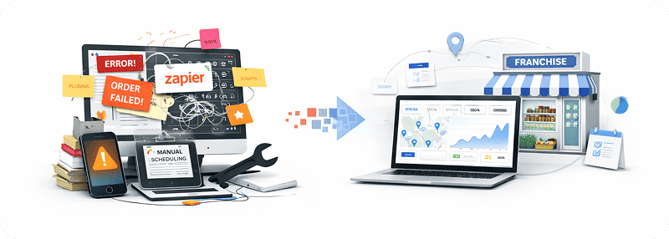
Stop juggling tablets — unify delivery apps into one interface.
If your operation depends on UberEats, Rappi, and other delivery apps, you’re not alone.
And if you’re managing multiple locations, you’ve probably experienced this firsthand:
- One tablet for UberEats
- Another for Rappi
- Another for direct orders
- Another system for delivery / drivers
- And a team constantly switching screens just to keep up
Even when sales go up, it often feels like profit goes down.
That’s why more restaurant brands and franchise teams are making a clear move:
|Stop paying commissions on every order — and start owning the platform.
In this post, we’ll break down what “commission-free” actually means, why it’s becoming the new standard, and how franchises are making the switch without losing demand.
1) The real problem isn’t getting orders — it’s running them profitably
Delivery marketplaces solved one big problem: instant demand.
But in 2026, the challenge isn’t “How do we get more orders?”
It’s:
- How do we manage orders from 4–5 different channels without chaos?
- How do we stop losing margin to commissions?
- How do we scale from 3 locations to 30 without breaking operations?
Because as you grow, what used to be “annoying” becomes expensive:
- more staff needed to manage tablets
- more mistakes and refunds
- slower fulfillment
- more customer complaints
- more support tickets
- less consistency across stores
2) Tablet overload is the hidden “tax” franchises pay every day
When teams are juggling multiple tablets, they’re paying a tax most businesses never calculate.
Cost #1: operational mistakes
Orders come in from different screens and platforms, and all it takes is one missed step:
- a missing item
- the wrong modifier
- a delayed order
- or a lost order entirely
Cost #2: slower preparation
Fragmented systems don’t create speed.
They create reaction mode.
Cost #3: no real visibility
For multi-location brands, it gets worse.
Each store ends up running differently — and leadership has no unified view.
Cost #4: commissions that drain margin
This is the final hit.
You do the work… and a platform takes a percentage of every order.
That’s why “commission-free” is becoming the next evolution.
3) What “commission-free” actually means (in real life)
Let’s clarify something:
Going commission-free doesn’t mean you suddenly stop using delivery apps.
It means you stop building your business on top of them.
The smarter strategy looks like this:
✅ Keep marketplaces as optional demand channels (when they make sense)
but…
✅ build a setup where your business is not dependent on them
In other words:
|Your brand owns the customer, the experience, and the data.
That’s the shift your competitors are making right now.
4) The smartest move: unify everything into one interface
The goal isn’t adding another tool.
The goal is removing complexity.
A modern franchise operation needs:
One interface. One workflow. One source of truth.
Instead of:
- 4 tablets
- 4 reporting dashboards
- 4 operational “rules” per location
You get:
- one unified order management system
- consistent workflows across stores
- clean reporting at scale
And when everything is unified, the results are immediate:
📉 fewer mistakes
⚡ faster fulfillment
📊 better control
💰 stronger margin per order
5) What a real franchise platform should include
Many brands try to patch the problem with temporary fixes.
But franchises need technology designed for scale.
A serious platform should give you:
Centralized control
So every store runs with the same standards.
Unified ordering
So direct orders + delivery apps can be managed from one place.
Operational visibility
Not just sales — but performance, fulfillment speed, delays, and location-level insights.
Brand ownership
Your website, your app, your checkout — not a marketplace experience with your logo in the corner.
Scalability
What works for 3 locations must work for 30+.
6) The real question isn’t “Which delivery app should we use?”
It’s: “Who controls the business?”
This is where the game changes.
If your growth depends on third-party platforms, your business is essentially renting demand.
And the problem with renting growth is:
-
fees go up, and you absorb the cost
-
policies change, and you adapt or lose orders
-
you can’t run real retention campaigns without customer data
-
scaling becomes more expensive than it should be
That’s why franchise leaders are moving toward a model where:
| Marketplaces are channels — not owners of the relationship.
7) Want to know if you should switch? Start with a 7-day audit
A practical audit to uncover:
-
where orders are being lost
-
where checkout friction is killing conversions
-
how delivery performance affects repeat customers
-
where commissions and inefficiencies are draining margin
-
what’s blocking your next stage of scale
No pitch. Just clarity.
8) Ready to see what “commission-free + unified ops” looks like?
If your brand is already growing, the next move is simple:
| Make growth profitable.
In a quick demo, we can show you how your operation would look with:
-
delivery apps unified into one interface
-
centralized franchise control
-
consistent customer experience
-
real-time reporting across locations
Final thought: your competitors aren’t just selling more…
they’re keeping more per order
And that’s the difference.
If you want to scale without chaos, you need infrastructure built for franchise growth.