



Share this
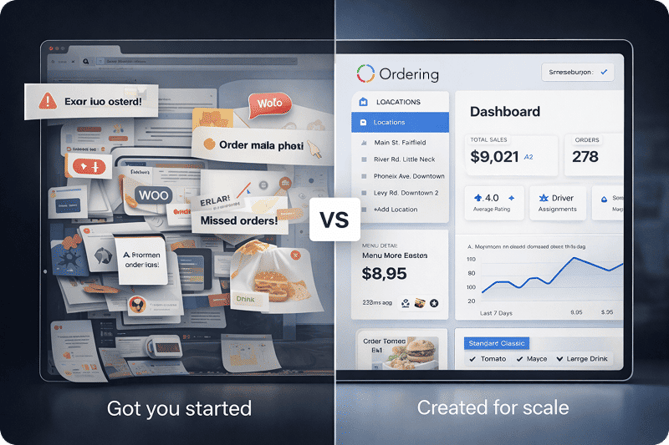
When you launch your first location, speed matters.
You use what’s available.
You connect tools.
You make things “work.”
And that’s fine — at the beginning.
But franchise growth changes the rules.
What helped you open your first store often becomes the first thing that breaks when store #10, #25, or #50 goes live.
This isn’t a failure of execution.
It’s a mismatch between MVP tech and franchise reality.
Growth Isn’t Just More Locations — It’s More Complexity
Scaling a franchise isn’t about adding dots to a map.
It’s about maintaining:
- Consistency across every location
- Reliability during peak demand
- Visibility across operations
- Control without slowing teams down
As complexity increases, fragile systems start to show cracks:
- Order flows depend on manual steps
- Data lives in disconnected tools
- Reporting becomes reactive instead of real-time
- Teams spend more time fixing issues than growing the business
Why “Vibe Code” Breaks at Franchise Scale
MVP stacks are designed to test ideas, not to sustain multi-location operations.
As chains grow, these setups usually rely on:
- Plug-ins stacked on top of plug-ins
- Automations patched together with no shared logic
- Store-specific fixes that don’t scale
- Best-effort uptime instead of guaranteed reliability
The result?
- Poor data visibility
- Endless patching
- No single source of truth
- Increased operational risk during promotions or high-demand days
The problem is fragility.
Growing Chains Need Infrastructure, Not Workarounds
Franchise operators reaching real scale need more than “working” tech.
They need infrastructure that supports:
- Brand control across every customer touchpoint
- SLA-grade uptime, not best-effort availability
- Custom menus, logic, and reporting that adapt per store — without breaking the system
This isn’t about overengineering.
- It’s about removing fragility before it shows up as:
- Lost orders
- Unhappy franchisees
- Broken reporting
- Operational chaos during growth spurts
Built for Franchises, Not Experiments
This is exactly the gap Ordering was built to solve.
Ordering.co and OrderingPlus aren’t MVP tools.
They’re infrastructure platforms designed for chains that are already growing — or about to.
In Mexico, international franchise brands like Burger King, Domino’s, and Pizza Hut rely on this kind of architecture to operate at scale.
- Using the platform, franchise operators achieve:
- Launch in 14 days, without rebuilding from scratch
- Full white-label ownership of brand, data, and experience
- Proven reliability at high order volumes
- Centralized control with store-level flexibility
Everything is centralized where it should be — and flexible where it matters.
- No fragile workarounds.
- No duct-taped logic.
- No surprises when store #25 opens.
Scaling Is a Maturity Decision
At some point, every growing franchise faces the same choice:
Keep patching what “worked before”
—or—
Adopt infrastructure built for where the business is going next.
If your next phase includes:
- More locations
- Higher order volume
- More operational visibility
- Stronger brand consistency
Ready to pressure-test your current setup?
Your next 20 stores shouldn’t be held together by code snippets.
Book your strategy call and see what real franchise infrastructure looks like at scale.