



Share this
For years, technical teams have been taught the same lesson:
If you want control, build it yourself.
Own the code.
Own the stack.
Own the infrastructure.
It sounds logical. Even responsible.
But in practice?
That belief has quietly become one of the most expensive myths in modern software businesses.
Because owning the code doesn’t guarantee control.
It guarantees responsibility.
And responsibility is not the same thing as results.
Code ≠ Control
Building in-house feels empowering at first. You choose the stack. You shape the architecture. You feel independent.
Then reality sets in.
Suddenly, “control” means:
- Maintaining infrastructure
- Managing uptime
- Fixing edge cases
- Planning migrations
- Staffing engineers for problems customers never see
Not just the features — but the bugs.
Not just the roadmap — but the delays.
Not just the system — but the risk.
Meanwhile, customers don’t care how elegant your backend is.
They care about whether the product works, loads fast, and delivers value.
Code doesn’t create leverage. Outcomes do.
What You Actually Need to Own
Real ownership has very little to do with repositories.
What matters — and what actually compounds over time — is ownership of the things that move the business forward:
Your brand
Your product should look, feel, and behave like your company.
Not a generic tool. Not a developer experiment.
Your customer experience
From first interaction to repeat usage, experience is where trust is built — or lost.
Your data and performance
Insights, metrics, behavior, and growth signals belong to you.
They shouldn’t be fragmented, hidden, or fragile.
When you own these, you own the business.
Everything else is just plumbing.
The Hidden Cost of Custom Code
Custom builds don’t usually fail dramatically.
They fail quietly — over time.
The cost shows up as:
- Dev overhead that grows faster than revenue
- Missed launch windows because “one more thing needs fixing
- Scaling friction every time the business grows faster than the system
Ironically, the very thing meant to give you control becomes what slows you down.
What Real Ownership Looks Like with Ordering
Ordering.co was built around a simple idea:
You should own the business outcome — not the technical burden.
With Ordering:
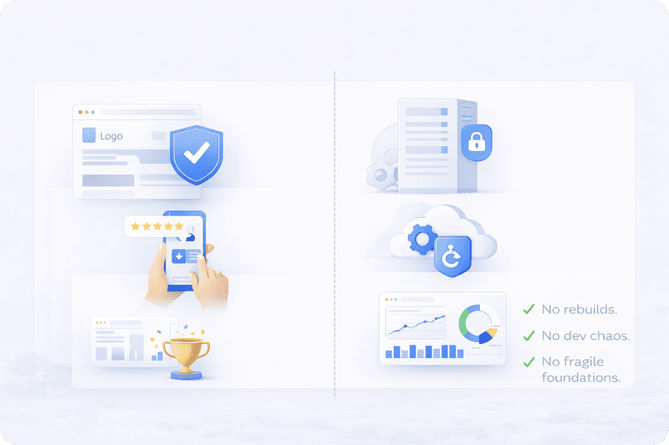
- You own the brand
- You own the customer experience
- You own the data
- You own the results
We handle:
- The platform
- The infrastructure
- SLAs and uptime
- Continuous improvements and scale
No dev chaos.
No fragile foundations.
You launch faster, operate with confidence, and scale without technical debt holding you hostage.
Own the Business — Not the Bugs
There’s nothing wrong with loving code.
But code is a tool — not the goal.
The companies that win long-term aren’t the ones with the most custom software.
They’re the ones that ship faster, learn quicker, and stay focused on outcomes.
Book your strategy call.
Own the business — not the bugs.