



Share this
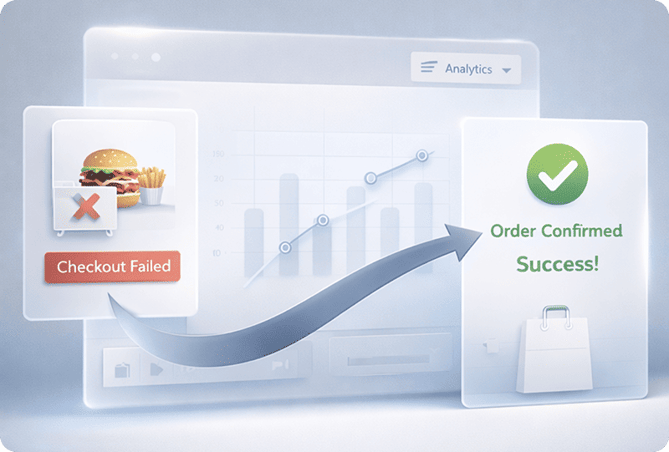
If last season felt “busy” but revenue didn’t grow the way it should’ve… you’re not alone.
Most restaurants, franchises, and multi-location brands don’t lose orders because demand isn’t there.
They lose orders because of conversion leaks.
That means customers are getting close to buying… and then something breaks, slows down, or feels confusing — and they leave.
The result?
You don’t just miss a few orders.
You miss hundreds.
And the worst part is: you usually don’t even notice it happening.
Let’s fix that.
The Real Problem Isn’t Marketing. It’s Conversion Leaks.
Most operators assume missed orders are caused by:
-
“We need more traffic”
-
“We need more ads”
-
“We need better promos”
-
“We need more followers”
But here’s what we see in benchmarks across brands that rely on online orders:
Customers are already searching.
Customers are already clicking.
Customers are already browsing the menu.
They’re just not completing the purchase.
That’s a conversion leak.
What Conversion Leaks Look Like (In Real Life)
Conversion leaks show up in different forms depending on your operation — but they usually fall into the same patterns.
1) Customers reach checkout… then abandon
This is the most common leak.
They want to order, but:
-
checkout takes too long
-
the experience feels “heavy” on mobile
-
too many steps
-
payment options aren’t convenient
-
address validation fails
-
the cart resets
-
the page loads slowly
Even small friction creates a big drop in completion rate.
When your checkout leaks, you lose orders every day.
2) Too many tools, no unified system
If you’re running multiple channels, you’ve probably felt this:
website ordering
delivery
pickup
promos
loyalty
staff operations
reporting
third-party marketplaces
When each part lives in a different place, you don’t just lose time.
You lose consistency.
And consistency is what makes ordering feel ea
3) Marketplaces keep the relationship (and your margin)
Marketplaces can bring demand, but they also create 3 long-term problems:
Fees eat profit
You don’t own the customer relationship
You don’t control the ordering experience
That’s why direct ordering isn’t a “nice to have” anymore.
It’s the difference between:
building a brand that grows
or renting your revenue from platforms
4) No real visibility into where orders break
This is the silent killer.
Most teams can’t answer questions like:
Where do customers drop off most?
Which step causes the most abandonment?
Is it worse on mobile or desktop?
Which locations convert better (and why)?
What’s the difference between high-performing stores vs low-performing stores?
If you can’t see the leak, you can’t fix it.
The Good News: Most Leaks Are Fixable — Fast.
This isn’t a “rebuild everything” situation.
In most cases, it’s about:
improving the ordering flow
reducing friction
standardizing the experience
giving customers a faster path to checkout
aligning delivery/pickup rules with real operations
When you do this right, you recover orders you didn’t even know you were losing.
And you can scale that improvement across every location.
What We Show You in a 15-Minute Demo
In a short demo walkthrough, we’ll show you:
✅ A fully branded ordering experience (website + mobile-ready checkout)
✅ Where your conversion leaks are happening (and why)
✅ How to increase completion rate and average order value (AOV)
✅ Delivery / pickup rules aligned to your operation
✅ A rollout plan that works for your team (single store or multi-location)
And here’s the key:
| Even if you don’t move forward, you leave with clarity on where you’re losing orders today.
That alone is valuable.
Why This Works (And Why Big Brands Do It)
This isn’t theory.
It’s infrastructure.
The same type of system enterprise brands use to handle thousands of daily orders, reduce marketplace dependency, and keep customers inside their own ordering flow.
When your ordering experience is:
-
fast
-
consistent
-
mobile-first
-
branded
-
unified
…customers complete the order more often.
That’s how you recover missed orders.
And that’s how you grow direct revenue without needing to spend more on ads.
Final Thought
If last season you missed out on hundreds of orders, it doesn’t mean your business is failing.
It means your system is leaking.
And leaks are fixable.
The fastest way to start is simple:
-
find the drop-off points
-
remove friction
-
standardize the flow
-
recover orders
-
scale what works
Ready to recover missed orders?
Ready to recover missed orders?